

Even the most rabid of Barack Obama supporters (you know who you are) would have to admit that, recently, the “candidate of change” has made a few mistakes. The man makes risky decisions and hopes that people will understand his reasoning. Sometimes the risk is worth the reward, and Obama is praised with the buzzwords you’ve all heard enough times that there is no need for me to repeat them. Sometimes, though, Obama’s comments and actions are seen as the shocking follies of an inexperienced and naïve candidate who simply can’t break free of his ideals. The reason I am concentrating on Obama and not Hillary Clinton or John McCain as well is because the other candidates do not have these problems. Obama’s attempts to break the stereotype of the dishonest politician separated from the people and using any means necessary to win have caused unique problems to come up, and his directness and sincerity have only put him in precarious situations. While the risks Obama takes, such as addressing controversial subjects or not giving up parts of himself that are less than savory to the American public, have frequently received a positive response, by acting like other politicians, he could avoid these risks altogether and achieve a more stable and secure lead.
Every politician makes mistakes, but Barack Obama needs to start approaching his own like most politicians do. The best example of what I mean can be seen in Hillary Clinton. Clinton had often claimed that the plane she was in on a trip to Bosnia in 1996 had come under sniper fire, once saying “I remember landing under sniper fire. There was supposed to be some kind of a greeting ceremony at the airport, but instead we just ran with our heads down to get into the vehicles to get to our base.” Recently, however, it was revealed that Clinton’s remarks were untrue, and there was even video footage that showed her walking calmly along the tarmac and stopping to kiss a young girl. When questioned about the issue, Clinton did not reaffirm her claims or try to explain the issue away. Instead, she used the classic political tactic of shifting blame (she claimed she was merely repeating what someone told her), avoiding the issue (she never did explain why she spread the story after stepping off the plane and realizing that there was blatantly no danger), and moving on (while it’s become a common joke against Clinton, note how little time the issue spent in the public’s eye).
Now take Barack Obama. He rarely runs attack ads or uses any sort of mudslinging on the grounds that they are shameful things to do. And they are shameful things to do, but Obama can’t expect the campaign for the most important job in America to be civil. He’s been lucky that most of Clinton’s attacks have backfired because if the attacks were more effective, Obama would never have achieved many of his successes. Obama’s sincerity and humanness, and the problems with the two, were nowhere more obvious than in his handling of the Reverend Jeremiah Wright controversy. First off, those entering the political realm are wise to disassociate themselves from anything that could come back to bite them in the future. Obama stayed connected to Wright, the seemingly (I only use seemingly because, at this point, the man’s true beliefs have been muddled beyond comprehension) racist anti-American reverend of a church that said Louis Farrakhan “truly epitomized greatness.”
When the controversy arose, instead of explaining that he technically wasn’t associated with the church anymore or that he should have left it a long time ago, he explained that Wright had been his friend and reverend since childhood, and that he himself does not hold Wright’s beliefs, but does not hate the man. Sure, this was the honest, sincere answer, but it merely added fire to the controversy. His honesty, unusual for a politician, dug him deeper into the hole that the controversy had created. Later, he delivered a speech devoted to the topic of race in America. Groundbreaking for a politician, sure, but not the politically sound thing to do. While clearly not a positive tactic, it is nevertheless true that (to avoid losing votes) candidates must avoid any and all controversial issues. Obama was lucky his speech on race went over well. In making his recent comments that Americans cling to guns and religion, though, he was not so lucky. It may have been his honest opinion, but this honesty certainly didn’t help his campaign.
Understand that I do not think that this idea of a new, honest politician who states his true beliefs, as opposed to merely what is safe, is a bad thing. I support Obama, and it is for that reason that I want him to be more careful, even if that means giving up just a little of the personality and sincerity that has made him the revolutionary candidate he is believed to be. If Obama goes up against John McCain, he’ll need to ease up on his respectable act and start trying to win voters through the use of means that are more standard and less sincere. Unfortunate, yes, but those tactics are also the only ways to stay ahead in a competitive political race for the highest office in the world.
Read more!
Saturday, May 10, 2008
Obama's Mistakes: The Reverend Wright Controversy

Saturday, April 19, 2008
See Hillary Run
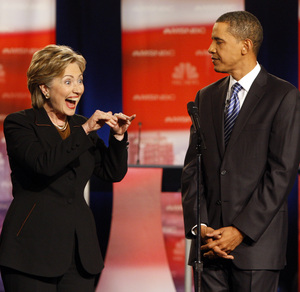
As yet another month of presidential primaries drags on, Democrats seem to be no closer to deciding on a presidential nominee. The two main contenders, frontrunner Sen. Barack Obama of Illinois and Sen. Hillary Clinton of New York, continue to drag each other down into the mud in hopes of gaining an advantage in the upcoming primaries. Meanwhile, the presumptive Republican nominee Sen. John McCain of Arizona is using his ‘opponent free’ time to reintroduce himself to voters and catch up on fundraising. In many recent polls, John McCain has tied with both Democrats in projected results of the November election. When former state senator George Bachrach spoke at Beaver earlier this year, he called the 2008 election “the Democrats’ race to lose”. Historically, it is rare to see a single party hold the White House for more than two terms, especially when the existing administration suffers from low approval ratings. However, with these lengthened primaries, it seems that the Democrats may have lost the advantage they once held over John McCain and the Republican Party.
Despite Clinton’s large base of support, there seems to be a growing consensus that she will not win the Democratic Presidential nomination, and that she should withdraw from the race for the good of the party. Senator Patrick Lehay of Vermont was recently quoted, saying, “There is no way that Senator Clinton is going to win enough delegates to get the nomination. She ought to withdraw, and she ought to be backing Senator Obama”. Experts say that there is a less than 5% likelihood that Senator Clinton will win the nomination, and yet she still says that she will not withdraw from the race until the DNC in August. Senator Clinton claims that there are many states left where she is still very competitive, and that she will not withdraw from the race if there are still states which she can win. Hillary’s claim is true, she can still win in Pennsylvania, and Ohio, but unless she sweeps Barack in all of these states, Hillary will not be able to gain the votes needed to secure the nomination. Super delegates, while important, will not completely skew the election. Hillary can still finish strong by bringing home some important states, but ultimately, she will most likely finish short.
Many say that there is nothing wrong with Sen. Clinton staying in the race, that she still may win the nomination, and that even if she doesn’t win, the feeling of competition that Clinton brings can only help Sen. Obama when it comes election time. This argument does have its points. It is true that a healthy sense of competition harms no one. However, when the competition resembles a death match, it only harms those involved. Slinging mud at your opponent will not help make them stronger, it is instead helping your opponent. When Clinton continues to question Obama’s experience levels, stating that he will not be ready to enter the White House on day one of presidency, she is not boosting her ratings, she is simply lowering his. The two Democrats seem to forget that it is not each other they are fighting. They should not view each other as enemies, but rather, allies.
I feel as though Hillary’s refusal to step down is seriously harming the Democratic party. Battle lines have been drawn, and Democrats are split down the middle. Indeed, in Beaver alone, fierce arguments were commonly erupting in the hallways and classrooms between Clinton and Obama supporters. Yet I don’t understand; who is this helping? How does Clinton benefit from the hatred of Obama supporters? How does Obama gain anything by having Micah Telegen attack the junior senator’s credentials? Nothing good is coming from this lengthened and hateful competition. Obama supporters refuse to vote for Clinton should she become the nominee, and many Clinton supporters feel the same way about Obama.
So why does Hillary stay in the race? Understandably she was the predicted nominee from early on, and many had expected her to become the next president of the United States. After all who could possibly defeat the Clinton machine? Certainly not a first term senator from Illinois who had served in the US senate for merely 3 years before he announced his plans to run for the highest office. At the time, such a scenario seemed absurd. However, that is exactly what happened. Whether Clinton refuses to believe this to be the case, or whether she still is holding on to that 5% chance that she can become commander-in-chief, she remains in the running to become the Democratic nominee. But one is left to wonder, ‘why does she continue to run? When will she stop? And where will she take the Democratic Party?’
Read more!
Monday, February 4, 2008
Youth Demand Change in Upcoming Election
 JARED BELLOT '08
Maria Montessori once said, “If help and salvation are to come, they can only come from the children, for the children are the makers of men.” Surly her words have held true in the past; the youth of the 60’s played a major role in enacting social change as can be seen through the Civil Rights Movement and the rise of feminism, while the children of the 70’s made their voices heard through the hippie movement and the rise of the gay rights activism. However, more recently, the young people of America have failed to make their mark on the country. Young voter turnout has been less desirable in recent elections, despite past efforts to raise participation and arouse some sort of general interest in the political process. No matter how many times we have been threatened to “vote or die”, the youth of America have maintained a steadily declining role in the political process since the close of the Vietnam War.
Today, these young voters, who for years have been virtually non-existent on the political landscape, have burst onto the scene and established themselves as an incredibly powerful force in politics. In the 2004 elections, youth voter participation (ages 18 to 24) was up to 47%, from just 36% in the 2000 elections, and things are only looking up, many arguing that this new generation will exceed the power and influence of the young protesters of the Vietnam era. A recent article in the Boston Globe attributes this increase in participation to the September 11th terrorist attacks and the current crisis is Iraq.
The way in which the country and the current administration have dealt with these national issues has outraged a number of American youth, and they have decided the time has come to remind the country that they too are affected by the choices made by their elders. After all, it is our generation who will inherit the consequences of the War on Terror, and it is our generation who must cope with the effect of global warming on our planet. These youths are fed up with the same old partisan battles that have been raging in the halls of congress for decades. They are tired of seeing democrats and republicans who always separate based on party lines, and refuse to reach across the aisle to get the job done, and they now understand that they can make a difference. The youth have seen with their own eyes what can happen when one chooses not to speak up. They were awoken from the slumber of political comforts and privileges granted to them by their elders, and confronted with a harsh reality. Today, these youth desperately want change, and they want it now.
It is this call for change by the youth that has had the biggest effect on the current race. When Senator Obama announced that his campaign would focus on a new type of politics, a politics of hope, young people from around the nation, republican and democrat, rallied around this first term senator from Illinois. Despite Obama’s “issue” of inexperience brought up by other candidates, Obama’s call for change struck a chord in first time voters. They joined his campaign, and for the first time in far too long, re-took their place in politics, in effect forcing the other politicians to listen to this call for change. Senator Clinton of New York, a staunch advocate of the need for experience in for the presidency, is now also speaking of the ways in which she would be able to bring change to the country. This block of youth voters has become larger than it ever has been in recent years, and candidates vying for the presidency are forced to take them in account when planning out their campaigns. This becomes evident as politicians turn to the internet more than ever before. Candidates have their own websites, Myspace pages and Facebook groups. YouTube has become an invaluable tool, and a bitter enemy as everything a candidate says is recorded and can be played back instantly anywhere across the nation, at any time of the day. While door-to-door campaigning is still a powerful tool, it seems as though this generation has turned to the internet to get their candidate-of-choice’s message across (yet another sign of the changing times).
The need to cater to this large voting block has opened up a completely new window, and has changed the presidential field entirely. No longer can a candidate ignore the youth or this call for change, for the people who are demanding this matter in the upcoming primaries and caucuses, and when November shows up and the time to elect a new president arrives. And I think that it can be agreed that no matter what political party he or she comes from, the 43rd president of the United States will be forced to listen to the demands of a new generation of Americans: a generation which has been waiting listlessly in the shadows of their parents, frustrated with the lack of progress.
Milligan, Susan. "Youth Voters a Force in '08 Race." Boston.Com. 13 May 2007. The Boston Globe.
Image from: NY Times
Read more!

