
 MICHAEL FIRER '09
Even the most rabid of Barack Obama supporters (you know who you are) would have to admit that, recently, the “candidate of change” has made a few mistakes. The man makes risky decisions and hopes that people will understand his reasoning. Sometimes the risk is worth the reward, and Obama is praised with the buzzwords you’ve all heard enough times that there is no need for me to repeat them. Sometimes, though, Obama’s comments and actions are seen as the shocking follies of an inexperienced and naïve candidate who simply can’t break free of his ideals. The reason I am concentrating on Obama and not Hillary Clinton or John McCain as well is because the other candidates do not have these problems. Obama’s attempts to break the stereotype of the dishonest politician separated from the people and using any means necessary to win have caused unique problems to come up, and his directness and sincerity have only put him in precarious situations. While the risks Obama takes, such as addressing controversial subjects or not giving up parts of himself that are less than savory to the American public, have frequently received a positive response, by acting like other politicians, he could avoid these risks altogether and achieve a more stable and secure lead.
Every politician makes mistakes, but Barack Obama needs to start approaching his own like most politicians do. The best example of what I mean can be seen in Hillary Clinton. Clinton had often claimed that the plane she was in on a trip to Bosnia in 1996 had come under sniper fire, once saying “I remember landing under sniper fire. There was supposed to be some kind of a greeting ceremony at the airport, but instead we just ran with our heads down to get into the vehicles to get to our base.” Recently, however, it was revealed that Clinton’s remarks were untrue, and there was even video footage that showed her walking calmly along the tarmac and stopping to kiss a young girl. When questioned about the issue, Clinton did not reaffirm her claims or try to explain the issue away. Instead, she used the classic political tactic of shifting blame (she claimed she was merely repeating what someone told her), avoiding the issue (she never did explain why she spread the story after stepping off the plane and realizing that there was blatantly no danger), and moving on (while it’s become a common joke against Clinton, note how little time the issue spent in the public’s eye).
Now take Barack Obama. He rarely runs attack ads or uses any sort of mudslinging on the grounds that they are shameful things to do. And they are shameful things to do, but Obama can’t expect the campaign for the most important job in America to be civil. He’s been lucky that most of Clinton’s attacks have backfired because if the attacks were more effective, Obama would never have achieved many of his successes. Obama’s sincerity and humanness, and the problems with the two, were nowhere more obvious than in his handling of the Reverend Jeremiah Wright controversy. First off, those entering the political realm are wise to disassociate themselves from anything that could come back to bite them in the future. Obama stayed connected to Wright, the seemingly (I only use seemingly because, at this point, the man’s true beliefs have been muddled beyond comprehension) racist anti-American reverend of a church that said Louis Farrakhan “truly epitomized greatness.”
When the controversy arose, instead of explaining that he technically wasn’t associated with the church anymore or that he should have left it a long time ago, he explained that Wright had been his friend and reverend since childhood, and that he himself does not hold Wright’s beliefs, but does not hate the man. Sure, this was the honest, sincere answer, but it merely added fire to the controversy. His honesty, unusual for a politician, dug him deeper into the hole that the controversy had created. Later, he delivered a speech devoted to the topic of race in America. Groundbreaking for a politician, sure, but not the politically sound thing to do. While clearly not a positive tactic, it is nevertheless true that (to avoid losing votes) candidates must avoid any and all controversial issues. Obama was lucky his speech on race went over well. In making his recent comments that Americans cling to guns and religion, though, he was not so lucky. It may have been his honest opinion, but this honesty certainly didn’t help his campaign.
Understand that I do not think that this idea of a new, honest politician who states his true beliefs, as opposed to merely what is safe, is a bad thing. I support Obama, and it is for that reason that I want him to be more careful, even if that means giving up just a little of the personality and sincerity that has made him the revolutionary candidate he is believed to be. If Obama goes up against John McCain, he’ll need to ease up on his respectable act and start trying to win voters through the use of means that are more standard and less sincere. Unfortunate, yes, but those tactics are also the only ways to stay ahead in a competitive political race for the highest office in the world.
Read more!
Saturday, May 10, 2008
Obama's Mistakes: The Reverend Wright Controversy

Saturday, April 19, 2008
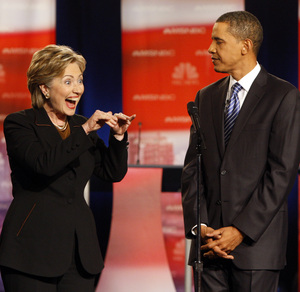
See Hillary Run
 JARED BELLOT '08
As yet another month of presidential primaries drags on, Democrats seem to be no closer to deciding on a presidential nominee. The two main contenders, frontrunner Sen. Barack Obama of Illinois and Sen. Hillary Clinton of New York, continue to drag each other down into the mud in hopes of gaining an advantage in the upcoming primaries. Meanwhile, the presumptive Republican nominee Sen. John McCain of Arizona is using his ‘opponent free’ time to reintroduce himself to voters and catch up on fundraising. In many recent polls, John McCain has tied with both Democrats in projected results of the November election. When former state senator George Bachrach spoke at Beaver earlier this year, he called the 2008 election “the Democrats’ race to lose”. Historically, it is rare to see a single party hold the White House for more than two terms, especially when the existing administration suffers from low approval ratings. However, with these lengthened primaries, it seems that the Democrats may have lost the advantage they once held over John McCain and the Republican Party.
Despite Clinton’s large base of support, there seems to be a growing consensus that she will not win the Democratic Presidential nomination, and that she should withdraw from the race for the good of the party. Senator Patrick Lehay of Vermont was recently quoted, saying, “There is no way that Senator Clinton is going to win enough delegates to get the nomination. She ought to withdraw, and she ought to be backing Senator Obama”. Experts say that there is a less than 5% likelihood that Senator Clinton will win the nomination, and yet she still says that she will not withdraw from the race until the DNC in August. Senator Clinton claims that there are many states left where she is still very competitive, and that she will not withdraw from the race if there are still states which she can win. Hillary’s claim is true, she can still win in Pennsylvania, and Ohio, but unless she sweeps Barack in all of these states, Hillary will not be able to gain the votes needed to secure the nomination. Super delegates, while important, will not completely skew the election. Hillary can still finish strong by bringing home some important states, but ultimately, she will most likely finish short.
Many say that there is nothing wrong with Sen. Clinton staying in the race, that she still may win the nomination, and that even if she doesn’t win, the feeling of competition that Clinton brings can only help Sen. Obama when it comes election time. This argument does have its points. It is true that a healthy sense of competition harms no one. However, when the competition resembles a death match, it only harms those involved. Slinging mud at your opponent will not help make them stronger, it is instead helping your opponent. When Clinton continues to question Obama’s experience levels, stating that he will not be ready to enter the White House on day one of presidency, she is not boosting her ratings, she is simply lowering his. The two Democrats seem to forget that it is not each other they are fighting. They should not view each other as enemies, but rather, allies.
I feel as though Hillary’s refusal to step down is seriously harming the Democratic party. Battle lines have been drawn, and Democrats are split down the middle. Indeed, in Beaver alone, fierce arguments were commonly erupting in the hallways and classrooms between Clinton and Obama supporters. Yet I don’t understand; who is this helping? How does Clinton benefit from the hatred of Obama supporters? How does Obama gain anything by having Micah Telegen attack the junior senator’s credentials? Nothing good is coming from this lengthened and hateful competition. Obama supporters refuse to vote for Clinton should she become the nominee, and many Clinton supporters feel the same way about Obama.
So why does Hillary stay in the race? Understandably she was the predicted nominee from early on, and many had expected her to become the next president of the United States. After all who could possibly defeat the Clinton machine? Certainly not a first term senator from Illinois who had served in the US senate for merely 3 years before he announced his plans to run for the highest office. At the time, such a scenario seemed absurd. However, that is exactly what happened. Whether Clinton refuses to believe this to be the case, or whether she still is holding on to that 5% chance that she can become commander-in-chief, she remains in the running to become the Democratic nominee. But one is left to wonder, ‘why does she continue to run? When will she stop? And where will she take the Democratic Party?’
Read more!
Thursday, April 17, 2008
Jury Duty Is No Joke
 JAN DEVEREUX
Ed. note: while so far the content of the Beaver Reader has been dominated by high school students, we welcome contributions from all members of the community, including middle schoolers, faculty, alumni, and parents. The following is a guest editorial by Director of Communications and parent ’07 Jan Devereux.
Once you turn 18, you become eligible for jury duty. Apart from serving in the military, jury duty is the most important civic responsibility a U.S. citizen has. Voting is also important, but as a juror you hold a fellow citizen’s fate in your hands. As the judge I sat before today described it, jury duty is an “awesome” responsibility – that’s awesome in the original sense of the word. As she reminded us, America is one of the few countries in the world that entrusts ordinary citizens with such an awesome power.
Yet most of us are annoyed when we are called to report for jury duty (it can be as often as every three years for a Massachusetts resident). Let’s be honest, there’s never a convenient time to wait around a courthouse with a bunch of strangers and no cell or Internet access. They don’t even sell coffee in the courthouse. The majority of those summoned spend the day waiting without being chosen, and go home feeling like the court has wasted their time. For the self-employed, jury service can be a financial hardship, too. Like others, I have joked with my friends about ways to avoid getting picked as a juror: “Just say you don’t trust the police, or cross your arms and glare at the defendant. That’ll get you off the hook.” Even without resorting to such tactics, I had never been selected for a jury. Until today.
And, after today’s experience, I will never again joke about jury duty. I learned it is no laughing matter.
With about 200 other potential jurors, I reported to the Middlesex Superior Court in Woburn at 8:00 this morning. As part of our orientation, we watched a video that explained courtroom procedure and reminded us of our duty to remain impartial. While the video’s cheesy production values were ripe for an ironist’s snickers, its solemn message was straight out of a high school civics book. Innocent until proven guilty. Beyond a reasonable doubt. Decide only on the evidence presented.
After three hours of waiting, I was chosen (“impaneled”) to sit on the criminal trial of a young man accused of two counts of illegally possessing a firearm. Conviction of a weapons offense would likely mean jail time for the defendant. A visibly pregnant young woman, probably his wife or girlfriend, was the lone spectator in the courtroom. Our jury’s decision would affect not only the defendant, but also his unborn child. As I raised my right hand and swore to uphold the laws of the court, I felt the full weight of my awesome responsibility.
I’ll never know whether I was selected because the prosecution figured that as a well-educated professional and a resident of the People’s Republic of Cambridge I support the strict enforcement of gun laws (I do), or whether the defense hoped that as a mother I might have a soft spot for the clean-cut young defendant with a baby on the way (I might). I never got the chance to prove my impartiality because another juror’s careless joke got us all dismissed even before the opening arguments.
Right after the selection process concluded, we jurors were escorted to a small waiting room where a uniformed court officer explained that the trial might last up to three days. At that point another juror blurted out, “It’ll be a short trail – he’s guilty. Ha-ha.” The rest of us squirmed, stunned at his inappropriate “joke.” This guy was probably the same fool who would joke about having a bomb as he went through airport security. The court officer was obligated to report the “joke” to the judge and the attorneys, who ultimately decided that the joke had prejudiced us all, and we could no longer be trusted to remain impartial. The judge scolded us about disrespecting our awesome responsibility and wasting the court’s time and our own tax dollars. All of us were dismissed, and the selection process would start over with a fresh group of untainted jurors. The defendant’s day in court would drag on a few hours longer.
Ironically, being sent home midday and excused from jury duty for another three years was the outcome the joker and most others had hoped for. He probably thought he had done us all a favor. Equal parts relieved to be sprung by lunchtime and disappointed not to be able to prove myself a worthy juror, I wondered how the joker would feel if he ever found himself in court, either as a defendant or a victim, and heard a juror joke about his case. If he keeps joking around, he won’t have to wait long to find out.
Image from beavela at Flickr.
Read more!
Friday, April 4, 2008
Creative Commons: Some Wrongs Reversed
 TOPH TUCKER ‘08
Here’s something you may not know: every piece of work produced is automatically protected by full copyright law. Every piece, including this newspaper—until now.
With the rise of modern computers and the internet, so too has the world seen a boom in sharing, collaboration, remixing… and copyright infringement. Every Beaver student has probably gotten the plagiarism talk at least half a dozen times, and we all know how Google and the web make it more tempting than ever to just copy and paste whole chunks of work done by other people. And we know how that’s wrong. And it is.
But life is not a history paper. When you’re talking, not about the serious study of the rise and fall of civilizations, but about a movie you saw the other day, doesn’t copyright law seem like overkill? Another thing you may not know: no matter how well you format your MLA citations, you’re only allowed to quote so much before it goes beyond “fair use.” So while emailing your friend a link to a review is fine, emailing the whole review—even if you also include a link—may technically be illegal.
What if that’s more strict than even the creator wanted? Enter Creative Commons. It’s meant to fill the gap between All Rights Reserved and no rights reserved, between full copyright and the public domain. And starting today, The Beaver Reader is being published under a Creative Commons Attribution-Share Alike 3.0 United States License. Basically, readers are allowed to share and remix our work as much as they want, just as long as they give us credit and don’t impose harsher restrictions on any work they base on our work.
It’s not as if it will make a big difference; it’s not as if anyone can track whether people are copying our work or giving us credit anyway. So from a reader perspective, almost nothing has changed. It’s as much a gesture as anything else. We support a culture where information flows freely. And by ending each page with “Some,” not All, “Rights Reserved,” perhaps we have reversed some wrongs.
Read more!
Tuesday, April 1, 2008
On Dedham
 LUCAS JUDSON ’13 (middle school)
Dedham is by far the awesomest town ever. Tons of cool people that would take too long to list are from Dedham, the awesomest sports are from Dedham, cool stuff is from Dedham, and Dedham House of Pizza is awesome.
Read more!
Tuesday, March 11, 2008
Voicing Concerns: A Letter to the CEO of Abercrombie & Fitch
EMILY BELOWICH '11
Dear Mr. Jeffries:
I am writing to tell you about how the sizing of your clothes can impact a young woman’s body image and how that might affect the way in which you market and sell merchandise. I am a 14-year old girl and a freshman in high school. I am five foot seven and weigh approximately 123 pounds. I participate in two varsity teams at school, cross country and basketball. I work out a lot, take good care of my body; I eat right, and care very much about the way I look. I know for a fact that many girls like me are interested in your merchandise, so I hope you will hear what I have to say as a customer.
Last weekend I went into one of your stores, Hollister Co., in Natick, MA, to look for jeans. The last time I shopped there I bought a pair of corduroys, size three. When I walked into your store, a saleslady asked if I needed help finding anything. I told her I was looking for a pair of jeans, size three. She took out two pair of jeans for me to try on. When I got into the fitting room, I tried on the jeans. I could not button either pair, and the jeans were too short. I was confused; I am normally a size two or three, or a 27 wide, and these jeans were labeled a three long. I did not understand why this size wouldn’t fit when all of my other pants this size fit without a problem. I became so upset at what I thought was a change in my body that I ended up leaving the store in tears. Overall, I did not have a good experience shopping here. In fact, I didn’t really have any intention of going back to the store again at that point in time.
As you are well aware, body image is such an important issue for girls, especially teenagers. I think that in order to prevent an experience like this from happening again, you should train the salespeople to first look at customer closely, suggest that the customer bring in a few sizes and tell the customer that the sizes run small. It would not only benefit the customer, but it could even increase the sales in your company. It would have made me feel much better had I been told that the sizes run small. Knowing that, I wouldn’t have been upset trying on a size five. For me, the experience at your store wasn’t a great one. The experience of shopping at Hollister should be fun, not upsetting. I hope that you will take this feedback into consideration. I look forward to hearing from you.
Sincerely,
Emily S. Belowich
Read more!
Monday, March 3, 2008
Passive Acceptance: Beaver's Liberal Ideology
 SAM O'REILLY '09
"The progressive school teaches the child to think for himself instead of passively accepting stereotyped ideas. It keeps always in mind that each child is different from every other, and that what makes an educated person useful in his particular walk of life, what makes him interesting, what makes him an individual, is not his resemblance to other people, but his differences."
-John French
It’s the convocation day. I walk into Bradley Hall with a snazzy shirt Mr. Manning let me borrow and a bowtie from Mr. Greenberg’s room. Just before I take my seat in the back row, I say to a teacher, “Above or below five minutes when the word ‘Progressive’ is used for the first time.” She laughs and answers, “Below.” I promptly take my seat next to Clay and have some time to marvel at his beard. Mr. Gow walks on stage. Guess what word was in his first sentence?
I am not saying that the fact that Beaver defines itself as a “progressive” school is a bad thing. In fact, it is something to be proud of. Beaver was one of the first so-called “progressive” schools to be founded. Some people may not realize how revolutionary the progressive education movement was at the time. Traditional education generally followed a script in which the teacher would talk, and the students would listen. This idea of progressive education centered on students thinking as individuals.
The progressive education movement was a success, and Beaver was an innovator in this entirely new field of thought. Progressive education today is immensely popular and helps many young independent thinkers. Progressive education has spread and is now extremely popular all across the country and the world. Much like any revolution, the progressive movement evolves. Such change is necessary for the progressive movement to remain progressive…to progress. Yet, how can Beaver continue to be progressive in a time of increased awareness of progressive values across the nation? In today’s world, what can Beaver do to further facilitate independent thought?
Do not get the ideas of being liberal and being progressive mixed up because they are completely different. Beaver is a particularly liberal school in a politically liberal region of the United States. I find the curriculum in the English and History departments have a very liberal slant. Take History, for example: there is too much history to cover, so the department must choose which parts are important for kids to understand. That’s understandable, but these issues are presented in a biased way. In the 10th grade, I was educated about the huge injustice of Americans driving Native Americans off their land. I could not help but think that the curriculum had an agenda of making students disagree with the expansion. One thing that was not presented to us was what our country would be like if we had not taken that land. Would we be as powerful as we are? We are generally taught to disagree with a capitalist conservative ideology. This is all rather ironic because that same ideology helps to pay for our cars, houses, private school tuitions, and video game systems.
I decided to go to Beaver because I agreed with the basic ideals. My parents did not suggest that I go to Beaver; I took the initiative to say that I wanted to go to this kind of school. Beaver is a very liberal school and there is nothing wrong with that. It is important, however, that we address this reality. I have been at Beaver since the 6th grade. I am currently experiencing my 6th year of Beaver curriculum and culture. When I first came to Beaver, I ate it all up. I ate every bite. I loved the idea of thinking for myself and learning from liberal minded people. Keep in mind I was an intensely opinionated sixth grader, whether I was informed or not. Bush was the devil, and Republicans ruled the world, and Michael Moore was the man.
I evolved over my middle school years. I can’t really pinpoint one moment when everything changed. I do know that it was around 8th grade when I came to the conclusion that the liberal agenda of Beaver was not always a good thing. I became concerned that the liberal mindset was too institutionalized. The ideology of Beaver generally attracts a very liberal staff. Kids do not appreciate how many teachers come to Beaver over potentially higher paying jobs because they agree with the core standards of the school. A generally liberal staff grouped with a generally liberal curriculum has created an institutionalized liberal ideology. The funny thing about it was that I agreed with all of the ideals that the curriculum was teaching. Nonetheless, the widespread passive acceptance of these ideas alarmed me.
I think that Beaver has unintentionally become a place that does not truly harbor independent thought. Throughout my years at the school, I felt as if I was being led in a general direction. Whether teachers realized it or not, they were leading students towards liberal ideals in the way they were presenting information. For example, when I was in the eighth grade, a writer for The Simpson’s spoke at our school. He gave a very interesting and funny speech about his experiences, and just so happened to call something “gay” and referred to Steven Hawkins as a nice “cripple.” I can understand that there would be some controversy after that, although what did people expect from a Simpson’s writer? For the next week, I think we talked about the issue in every class. In English, we even had to write an editorial about what we thought of the issue. All of the teachers were obviously offended and continued bringing up the issue. We were expected to be offended. We were supposed to view his comments as highly offensive. If we did not share the same disgust, then we were ignorant.
I saw some of my peers molded into a uniform liberal teenager. Perhaps they all would have come to this conclusion about the world in due time. I began to see people agree with everything that I generally agree with. The majority of my class hated Bush, but could not give a good reason why. Many people supported gay marriage, but had not stopped to consider the opinions and concerns of many other religious Americans. When I was assigned to put together a debate together for science about abortion, every member of my class supported it. About 57% of Americans share the same sentiment. This is just one example of how students have become products of their environment. I support abortion as well, but I am alarmed by the conformity of opinions.
I am not the only one who is aware of the institutionalized liberalism. It is hard to disagree with uniformly accepted liberal ideas. I know lots of kids that accept these ideas, but do not care about them. Many students do not actually believe in an opinion unless they are genuinely allowed to come to it own their own. I feel like so many people at Beaver have given up trying to oppose the common opinion. These liberal ideas, righteous as they may be, are such constants in our lives that they don’t matter anymore.
I know a handful of kids at Beaver who do not agree with some very liberal ideas. They do not argue for them however because it is difficult to defend such an opinion. It is much easier to argue for gay marriage rather than against it because the “correct” opinions have already been implied to us through every class diversity day we have ever attended. It is logical to write a liberal minded paper because the ideas have already been laid out to us. Liberal thought used to challenge the general consensus, but now it is institutionalized.
Beaver is an environment where it is just much easier and much more rewarding to agree with liberal ideals. Although some teachers try to keep their opinions secret, it does not take a genius to deduct which side he or she is on. A friend once commented to me after a class, “Beaver does not teach you to think, it teaches you to reiterate ideals in an attempt to mold your personality.” Unlike other schools, Beaver does not emphasize the memorization of facts and dates. However, it does focus on the memorization and reiteration of ideals. Such uniformity in core ideas can be very dangerous.
Beaver needs to be a more self-reflective institution. It needs to take a hard look at itself and judge if it is a progressive institution in today’s world. I personally believe that the school would do itself a great service in attempting to eliminate passive acceptance of liberal idealism. Even if a student disagrees with the war in Iraq, along with the teacher and the rest of the students, it is the job of everybody to ask the question, “why?” It is the responsibility for every teacher, student, and administrator to challenge the common belief. Those of us that consider ourselves liberals must challenge our core ideals on a daily basis to remind ourselves of why they are our ideals. I believe that it is our responsibility, as students and citizens of the world, to guard against this habit of passive acceptance. If we cannot do this, then we can never expect to progress.
“Passive acceptance of the teacher's wisdom is easy to most boys and girls. It involves no effort of independent thought, and seems rational because the teacher knows more than his pupils; it is moreover the way to win the favour of the teacher unless he is a very exceptional man. Yet the habit of passive acceptance is a disastrous one in later life. It causes man to seek and to accept a leader, and to accept as a leader whoever is established in that position.”
-Bertrand Russell
CORRECTION 5/Apr/08: Mr. Gow's Cum Laude speech, read every year, does not mention progressive anything. His convocation day speech, though, does "proudly connect Beaver's heritage to the extraordinary work of the early Progressive Education movement." We are very sorry for the mistake.
Image from: http://www.bcdschool.org/
Read more!
Tuesday, February 12, 2008
A Discussion of Existence
CHRISTOPHER RUSH '08
I find it ironic; that despite all of man kind’s progress technologically, economically, and industrially, we are still clueless as to how to coexist. Man remains enthralled with trivial issues concerning the labels of gender, age, sexual orientation, and race. I feel that Bob Marley puts it best in his song, “War” when he says “Until the colour of a man's skin is of no more significance than the colour of his eyes me say war.” We focus so much on these ideas that make us different that we fail to realize and support the things that make us the same, our humanity. Even in our attempts to be diverse, we stress the importance of these labels so much so that we instead promote the fact that we are all different. It seems that human’s obsession with these issues and labels encourage the disregard of a larger picture; our own existence.
Theories behind existence have been contemplated and debated for thousands of years by men and women much smarter than most people in this room. Yet no logical answer has been found or proven. The presence of an afterlife is an idea with which we are all familiar. No matter what religion we associate ourselves with, whether it is Islam, Christianity, Buddhism, Judaism, Daoism, or Hinduism; we all know the idea of eternal life. Even those of us who might be atheist or agnostic for the most part still understand the basic ideas behind an afterlife. However, mankind is not new to the suggestion of an afterlife.
Neanderthals were the first species of the homo genus to show belief in an afterlife. Neanderthals are one of mankind’s closest relatives in evolution are believed to have coexisted in some places for about 12,000 years. Neanderthals were human’s last relative and are believed to have died out somewhere around 24,000 years ago. Through the excavation of Neanderthal gravesites, historians and archaeologists have found remains surrounded by objects much like the Egyptian tombs. The fact that Neanderthals were buried with these objects indicates that their peers believed they would somehow use them in the afterlife.
In the evolutionary race, it was our higher brain functioning that allowed us to succeed. Instead of relying on brute force or strength, humans relied on their ability to use tools, communicate, and out think their prey and predators. It is human’s ability to think and imagine that led to our rise to the top of the food chain. However, it is thinking that may also be mankind, and this planet’s downfall.
Religion teaches people across a broad spectrum the proper way to live life and treat others. Religion instills morals and values that keep the world functioning and succeeding. By offering the reward of an afterlife, religion gives people something to work for. The afterlife is mankind’s prize for being good. However, there are other methods besides religion that could instill the same ideals. Proper upbringing and education could teach mankind the need for these values in order to succeed. We could show our young through stories and parables examples of appropriate behavior and encourage the same values we see in the Bible.
One could also argue that this is actually the role of the Bible. That it is not to be taken literally, but rather simply interpreted and understood. The book itself is nothing but a book; a compilation of stories. Like any story it contains a theme and a moral. There are heroes and there are villains. The Bible contains symbolism and represents an idea way beyond human understanding. According to 20th Century psychiatrist Carl Jung, humans possess a collective unconscious. The idea behind the collective unconscious is that all humans are driven by archetypes, or a model person, personality, or behavior. Humans use these archetypes to achieve self-actualization and individuation. In other words, archetypes push humans to be the best that they can be and to achieve some notion of individuality. Theoretically, it is these archetypes which Jung discusses that allow mankind to progress and succeed as a society. One of the archetypes that exist in the collective unconscious is the hero. Throughout history mankind uses hero figures to teach lessons and instill values. Does this sound familiar? Is it possible that instead of worshipping the Bible and the characters in it that we were only supposed to learn from the stories? By focusing so much on important individuals and specific events are we missing the true message behind the book’s words? Are God and the other characters in the Bible simply archetypes in the collective unconscious meant to drive and inspire us?
In addition to Jung’s theory, there are theories that suggest the sub-conscious creation of God exists to lift the load of responsibility off mankind’s back. Without the existence of God, mankind is self-sufficient and therefore responsible for its own actions. This idea is known as existentialism. This theory suggests that it is humanities desire to have some meaning and essence that drives the creation of God. As humans, we want to know that we are special and that we have some purpose here. Our minds cannot grasp the concept of death. We can’t even begin to fathom the idea that once we’re dead our minds lose their abilities to think or imagine. So, we refuse to accept that this life is all that there is for us; that all the pain and death that surrounds us is only the prelude to a better end.
At the moment, humanity is still convinced and infatuated with the idea that this planet is unique. Out of the millions and millions of planets, what makes us think Earth is so special? We have not even come close to discovering all planets or parts of space and there remains so much beyond our own planet that we have yet to learn about. It is not until we come to understand this that we can take the next step in our evolution. I find it difficult to believe that this planet is it; that we are the most successful representation of life. I mean look at us, we can barely figure out how to coexist with each other; how can this tiny little planet possibly be it? I choose to believe that we are not special; that the pointless wars, the unnecessary suffering, and the judgmental ridicule that we put each other through is not possibly the best representation of life. I believe that there must be something else out there that supersedes us, but I am an optimist.
In the world beyond God there are alternate realms of thought that represent a more abstract approach to existence and what our purpose is. We all know the concept of the universe. Planets make up a solar system; a group of solar systems as well as gas, dust, and dark matter make up a galaxy; and finally galaxies are what make up our universe. No one knows for sure just how large the universe is; we do not know if it ends and if it does, what is beyond it? According to Einstein, the universe is a kind of sphere. If you go to the edge of the sphere you will theoretically return to where you started. At the same time however, the universe is expanding and growing; but what is the universe expanding into? In theory I find Einstein’s hypothesis to be confining. I would like to believe that there is more beyond the universe; that we are not limited to this supposed sphere. I don’t know, I might be the only one who feels this way, but it keeps me sane.
There is another theory that suggests the possibility of multiple universes. This concept is known as a multiverse. In a multiverse there are several universes, much like there are several planets that make up a solar system, several solar systems that make up a galaxy, and several galaxies that make up the universe. One could even take it a step further and say that this universe and everything in it is the equivalent to just a fingernail on a much larger being. I mean think about it, don’t our own cells work strikingly similar to the solar system? Electrons orbit the nucleus much like planets orbit the sun. Obviously I have no factual evidence to support this argument and if I did, I doubt I’d be in my fifth year of high school right now. The point is that we have a good deal left to learn and a good deal we may never know. For example, what came before the Big Bang? The event was caused by two atoms colliding, which means there had to have been something there, how did those atoms get there, or is the existence of nothing possible? Understanding our ignorance is an important part in understanding our own existence. There are questions to be answered we cannot begin to imagine due to lack of information. We must remain questioning in order to find the answers.
This questioning also applies to our faith in God. It is my belief that no man or woman can honestly claim to know that God exists. From what I know, there is no physical evidence or proof that there is a God or an afterlife. However, there is also no proof or evidence that God does not exist. The only honest claim a person can make concerning religion is that they simply do not know. This claim is the central idea surrounding the belief of solipsism. Solipsism is the philosophical principle that suggests the only existence that any one can be certain of is the existence of their own mind. The concept itself is very complex and confusing. In the simplest terms, it means that the rules and supposed laws of nature are actually man made and cannot be proven; therefore they do not exist. It is believed that the most certain facts are the thoughts and experiences of one’s own mind. Solipsism is a controversial approach to philosophy. It goes against the established norms of psychology and refutes the existence of commonly accepted scientific theories. Belief in solipsism typically emerges in cultures or environments where individuals feel that they have no hope. In time, solipsism has officially become known as “Debby Downer Mentality”, not to be confused with, “Negative Nancy Syndrome”.
Through my own observation, I have come to learn one very important lesson about humanity and this planet. That even through human’s amazing evolution and progress, we still have so much left to learn. This is an idea which I think we are all aware of but have never fully considered. Due to the technologies and sciences that humans possess, we believe that we know a lot. We believe that we understand a fair amount about life and this planet. However, we still know very little about this planet, and what exists beyond it. If we were to condense the Earth’s existence, which is estimated to be around 4.5 billion years, into 24 hours, man’s existence in these 24 hours would add up to be about 27 seconds. In the natural clock of earth, we would be considered “noobs”.
In today’s world our existence is being threatened. We are faced with an alarming number of problems that appear to only be getting worse. According to World Bank estimates, 2.7 billion people survive on less than $2 a day, which is defined as moderate poverty. 1.1 billion people live on less than $1 a day, which is defined as extreme poverty. The United Nations estimates that in 2003, 25,000 people a day died due to starvation and malnutrition. Additionally, with the build up of nuclear arms over the past 60 years, it is inevitable that at some point they will be used, the only question is when? Countries such as the United States and Russia have the nuclear capability to destroy the world several times over. We have harnessed the destructive powers of nature that could lead to our own annihilation. Humanity has reached a point where it can affect the world that we live in on a major scale. This is seen in global warming, an ongoing event where this planet is methodically being destroyed and the climate has the potential to change drastically due to human activity. It is very possible that we are nearing the global warming threshold; where we will have done so much damage to the atmosphere and to our environment, that we won’t be able to reverse the damage. Where’s the outcry? Where’s the plea for action? Do we even care?
We live in a revolutionary time; thanks to events taking place now, the next 50 years and what our generation does will be crucial in the survival of our species. This era could be the most influential and defining periods in human history. The seeds of man kind’s existence are in our hands, but we remain silent. As the possible failure of our species looms issues that are stressed as important by society such as race and sexual orientation do not seem all that important in the long run. I mean, in the end it is not our race or our so called “wealth” that will determine the success of our species. Only our understanding of this planet and the fragility of our own existence can lead us to action.
These circumstances will force our generation to answer a difficult question: what is more important to us, our political interests and policies or our specie’s existence? If we choose political interests, we will continue down the same path we are right now. We will continue to apathetically destroy in order to create. We will focus on today, not tomorrow, not yesterday, but today. If we choose existence, our lives will change significantly, you might see a more global effort at success instead of merely national efforts. Mankind might for the first time since the first stages of evolution work together as a species to correct these issues and fight for its own existence. However, in order to do this we must realize that we are not above the destructive forces of nature. We must understand that our existence is only possible because of nature and in the end it will be nature that will kill us. It is nature, not us, that gives us the means and possibilities to do great things; it is how we choose to use them that will determine our fate. We are only visitors on this earth and at some point we will be extinct. Humans are not unique in their existence. There was life before humans, and if we allow it there will be life after humans.
Socrates- “I am the wisest man alive, for I know one thing, and that is that I know nothing.
Read more!
Monday, February 11, 2008
Too Much Homework?
 ERIK TOBIAS '09
One of the most admirable aspects of the Beaver Country Day School is that it offers "progressive education" to its students. It is therefore ironic that Beaver's biggest flaw is that its high school students are inundated with homework. Junior year is notorious for weighting down the average student to the point of academic surrender. However, Beaver is becoming progressively mainstream because, just like every other high school, Beaver is piling on the homework. Beaver's mission is to offer its students "an academically challenging curriculum in an environment that promotes balance in students’ lives." The balance in student's lives is starting to deteriorate. School work, particularly academics and afternoon activities, are causing students to lose the balance that Beaver preaches. The homework load at Beaver is far too high and ultimately prevents students from performing their best in school and from pursing other activities outside of school. Beaver could truly be progressive if it were to limit homework to one hour per night, in addition to half an hour of reading. This would allow students to be well rounded and pursue other activities outside of school that kids should be able to do.
As a student, I have a very busy schedule. I wake up every morning at 6:15am and try to finish up bits of homework from the previous night. It is always a struggle getting out of the house considering I am trying to finish homework, get ready for school and leave the house all at the same time. Somehow, I manage to arrive at Beaver 15 minutes before class starts (Mr.Manning’s time cushion). I then spend the next seven or so hours in classes. I then travel from Beaver straight to golf practice for two hours. By the time I get home after golf practice, it is 6:00pm. I eat dinner with my family until 6:30. That is my only real break of the day. Then I begin the marathon. I receive at the minimum an hour of homework from each class. Considering that I take four classes, that adds up to about four hours of homework starting at 6:30pm.
The homework at Beaver is often drills information into your head. In Spanish, we might practice conjugating verbs, in math we might practice problems, in history we might work on a project, and so forth. The point is that the majority of the homework I receive does not actually teach me anything, but simply drills points made in class into my head. Hence, homework like this could be significantly reduced considering it is mostly "busy work." I understand that some busy work is necessary in order to completely comprehend information, but the amount I receive of it is significantly too high. I also understand that students do have an extended lunch period, but many students use that to see teachers for extra help. When the clock hits 11:00pm, I can barely keep my eyes open and I decide to go to bed even if I haven't finished my homework. On match days, I often get back to Beaver anywhere from 7:30pm-9:00pm. After a match, I am normally exhausted and have to begin my homework late at night. I have come to the conclusion that doing homework after a match is useless because there is no way I can retain anything when I am that tired. I simply scratch words on the paper just to get it done, not caring whether it is right or wrong.
With endless amounts of homework, children are missing some of the best times of their lives. As people get older, they often yearn to be young again. As my Dad says, "I am a 20 year old, trapped in a 50 year old's body." With that being said, I want to be able to take advantage of my youth. When my parents were kids, they didn’t have a lot of homework. They were able to pursue activities outside of school. With less homework, the possibilities are endless. I could get a job after school or volunteer part time at veterinary hospital. Maybe I could actually get involved in politics or pursue Model UN more seriously. Maybe I could practice music with my band. Maybe I could take up cooking. Maybe I could practice a sport or see my friends. All I want is to be able to be kid. While I am in school, the only time I can be a kid is from Friday night to Saturday night because Sunday is completely taken up by homework. High school should be one of the greatest times of my life; I don’t want to remember it by sitting at my desk doing homework. And yes, most of my homework simply requires a desk and computer: not very progressive.
This world is becoming overworked and over programmed. A few students and professors at Penn State actually did a study on how too much homework can be counterproductive. Statistics even prove that "many countries with the highest scoring students, such as Japan, the Czech Republic and Denmark, have teachers who give little homework. At the other end of the spectrum, countries with very low average scores -- Thailand, Greece, Iran -- have teachers who assign a great deal of homework.” In the 1980's, countries started to increase homework in response to performance in comparison to Japanese students. Conversely, Japanese schools were actually lowering amounts of homework. Studies show that math teachers currently in the US assign five-six hours of homework a week (too much) while Japanese schools give two-three hours a week. It has also been proven that working non-stop all day tends to reduce the amount of knowledge you can retain. Along those lines, many case studies have been done in order to show that if a teenager doesn't receive ten hours of sleep a night, his or her learning will be considerably less productive. On a normal day, I receive less than 7 hours of sleep because of homework; my learning is infringed upon considerably.
I realize that there isn't much I can do to change the schedule of my day, but there is room to change my life at home. If I were to get home after school and spend one hour doing homework and a half hour of reading, I guarantee my grades, cheerfulness, mood, extracurricular activities and general knowledge of the world outside of Beaver Country Day School would flourish. I understand that by doing less homework, you are learning less information, but only to a certain extent. The human brain can only retain so much work. As the renowned columnist Thomas Friedman said, "It's for all these reasons [that I have mentioned] that I've been calling them "Generation Q" -- the Quiet Americans, in the best sense of that term, quietly pursuing their idealism, at home and abroad." In other words, because we are so involved in school, homework and extracurricular activities, this generation is not able to formulate opinions and voice them; we simply don’t have time or energy to.
Every day, I notice kids that haven't done their homework and I am secretly proud of them. I know that they have spent time outside of school pursing something they wanted to do instead of doing homework. It just so happens that many of these kids are the most brilliant kids I know. Their grades might not reflect it, but somehow I know they will be just fine in life; doing it their way.
Read more!
Wednesday, February 6, 2008
Investigating Beaver's Fundraising Guidelines
 JEFF HIGGINS '08
For Beaver’s celebration of Martin Luther King and Social Action Day, Mr. Principe and a number of students organized a t-shirt drive. They charged t-shirts home for a ten-dollar price− a common practice at Beaver. They plan to donate the money to an undecided charity. Little did they know, their tee shirt drive broke a few school rules.
“We screwed up,” admits Mr. Principe in response to the incident. But the incident seems so innocent, so benevolent. All they did was sell t-shirts for an important cause--at 10 dollars, too, an unusually low price.
At Beaver, fundraising for charity breaks school rules. This, of course, includes Mr. Principe’s harmless sale of t-shirts. The following rules can be found on page 20 in the student handbook everyone received at the commencement of the school year:
All fundraising activities must meet the following criteria and be approved by the Director of Development:1. Fundraising must be for Beaver-related activities. Fundraising for other
I talked to Beaver’s Director of Development, Karen Hill, to try to understand why these guidelines are in existence. One of the focal reasons behind the guidelines is that fundraising for charity robs money from Beaver. The logic is: if parents are relentlessly hounded for money for x, y, and z charities, when the school asks parent to donate to the annual fund, they are likely to donate less money. Since the school rarely receives large endowments, Beaver relies considerably on the annual fund. Karen Hill elucidated that such charity fundraising would not only make it more difficult to raise money for the annual fund, but also for prom and other student activities.
organizations will not be allowed as it:
a) Implies a choice of one
organization over another and
b) Competes with efforts to support certain
organizations though the Hiatt Center.
2. Student-to-student fundraising is
permissible. Student to parent fundraising is not. No letters will be sent home
to parents asking them for donations.
3. The contribution limit is 15
dollars, whether for an outright donation or to purchase an item (food at a
game, flowers at a performance, t-shirts, etc.)
4. Students will not be
allowed to charge donations to school accounts.
In addition, restricting fundraising for charity apparently inspires students to support the community around us in others ways, such as through the Hiatt Center. The administration wants students to impart time and work hours, not just money. In addition, Ms. Hill also made the point that if there were nonstop, weekly fundraisers going on around the school, they would likely become disorganized, jaded, and unsuccessful. She also said the reason for the fifteen-dollar cap was to level the playing field for Beaver students who are not as wealthy as others.
In the words of Coach Will Morrison, “C’mon, you guys!” The fifth and final part of Beaver’s bullet-pointed Mission is “Serve both school and society with integrity, respect, and compassion.” This is a school that prides itself on events like the winter holiday celebration and on its strong relationship with the Hiatt Center. This is a school that boasts three faculty members solely devoted to community service, social action, diversity, and cultural issues. Yet, we are not allowed to fundraise for charity.
However, there is some fundraising allowed. For example, the Spare Change Drive to benefit soldiers fighting overseas. The drive was followed up with a Wednesday forum presentation, and was heavily influenced by the faculty. The drive was enormously successful. Just imagine though, without the school’s strict rules, individual donations could soar from 75 cents to 16 dollars. But wait! That would prevent parents from donating to the all-important annual fund.
Personally, I do not see the logic behind some of the guidelines. Fundraising is not allowed because it “Implies a choice of one organization over another.” Honestly, who has ever been ridiculed for donating to one charity over another? It is the equivalent of saying there can be no more fundraising to support victims of Hurricane Katrina because it would not be fair to organizations helping the AIDS epidemic in Africa.
Let us take a look at Mr. Principe’s t-shirts. What harm did that do to the annual fund? Technically, it was not even a fundraiser. The purpose of the drive was to spread awareness of Martin Luther King Day, so students would “make it a day on, not a day off.” Mr. Principe has not yet even counted how much money the drive made or decided upon a place to donate the money. Yet somehow, he “Screwed up.” The drive charged home shirts for a non-Beaver related activity.
Here is the bottom line: I think there should be momentous edits made to the guidelines. At a gut level, banning charitable fundraising is flat out wrong and even immoral. Giving charity and helping the needy is a fundamental value in our society. I like the idea of having fundraising activity approved by the director of development. Yet, do we really need to ban fundraising all together? I think not. If a student has a solid plan for a fundraiser, such as the spare change campaign, it should not be limited. If fundraisers are well planned and approved, I do not see the reason for a fifteen dollar cap, a ban from charging items home, or student-to-parent fundraising.
I wonder which unnecessary school rule Mr. Principe will undermine next.
Image from: John Wiley & Sons Publishing
Read more!
Monday, February 4, 2008
Youth Demand Change in Upcoming Election
 JARED BELLOT '08
Maria Montessori once said, “If help and salvation are to come, they can only come from the children, for the children are the makers of men.” Surly her words have held true in the past; the youth of the 60’s played a major role in enacting social change as can be seen through the Civil Rights Movement and the rise of feminism, while the children of the 70’s made their voices heard through the hippie movement and the rise of the gay rights activism. However, more recently, the young people of America have failed to make their mark on the country. Young voter turnout has been less desirable in recent elections, despite past efforts to raise participation and arouse some sort of general interest in the political process. No matter how many times we have been threatened to “vote or die”, the youth of America have maintained a steadily declining role in the political process since the close of the Vietnam War.
Today, these young voters, who for years have been virtually non-existent on the political landscape, have burst onto the scene and established themselves as an incredibly powerful force in politics. In the 2004 elections, youth voter participation (ages 18 to 24) was up to 47%, from just 36% in the 2000 elections, and things are only looking up, many arguing that this new generation will exceed the power and influence of the young protesters of the Vietnam era. A recent article in the Boston Globe attributes this increase in participation to the September 11th terrorist attacks and the current crisis is Iraq.
The way in which the country and the current administration have dealt with these national issues has outraged a number of American youth, and they have decided the time has come to remind the country that they too are affected by the choices made by their elders. After all, it is our generation who will inherit the consequences of the War on Terror, and it is our generation who must cope with the effect of global warming on our planet. These youths are fed up with the same old partisan battles that have been raging in the halls of congress for decades. They are tired of seeing democrats and republicans who always separate based on party lines, and refuse to reach across the aisle to get the job done, and they now understand that they can make a difference. The youth have seen with their own eyes what can happen when one chooses not to speak up. They were awoken from the slumber of political comforts and privileges granted to them by their elders, and confronted with a harsh reality. Today, these youth desperately want change, and they want it now.
It is this call for change by the youth that has had the biggest effect on the current race. When Senator Obama announced that his campaign would focus on a new type of politics, a politics of hope, young people from around the nation, republican and democrat, rallied around this first term senator from Illinois. Despite Obama’s “issue” of inexperience brought up by other candidates, Obama’s call for change struck a chord in first time voters. They joined his campaign, and for the first time in far too long, re-took their place in politics, in effect forcing the other politicians to listen to this call for change. Senator Clinton of New York, a staunch advocate of the need for experience in for the presidency, is now also speaking of the ways in which she would be able to bring change to the country. This block of youth voters has become larger than it ever has been in recent years, and candidates vying for the presidency are forced to take them in account when planning out their campaigns. This becomes evident as politicians turn to the internet more than ever before. Candidates have their own websites, Myspace pages and Facebook groups. YouTube has become an invaluable tool, and a bitter enemy as everything a candidate says is recorded and can be played back instantly anywhere across the nation, at any time of the day. While door-to-door campaigning is still a powerful tool, it seems as though this generation has turned to the internet to get their candidate-of-choice’s message across (yet another sign of the changing times).
The need to cater to this large voting block has opened up a completely new window, and has changed the presidential field entirely. No longer can a candidate ignore the youth or this call for change, for the people who are demanding this matter in the upcoming primaries and caucuses, and when November shows up and the time to elect a new president arrives. And I think that it can be agreed that no matter what political party he or she comes from, the 43rd president of the United States will be forced to listen to the demands of a new generation of Americans: a generation which has been waiting listlessly in the shadows of their parents, frustrated with the lack of progress.
Milligan, Susan. "Youth Voters a Force in '08 Race." Boston.Com. 13 May 2007. The Boston Globe.
Image from: NY Times
Read more!
Thursday, January 17, 2008
Clichés are the Best Medicine: High School Musical
 JESSICA PENZIAS ‘08
For a little context, High School Musical’s pedigree includes such films as Zenon: Z3 (“The Zecond Zequel”) and Brink, so you can be excused for underestimating it. This high school comedy, in which students often break into enthused song and dance, is often ridiculed by those over the age of 11. These people tend to mock the convenient plot lines and the not-so-subtle lessons the movie provides. The movie enforces such clichés as “what goes around comes around,” “tomorrow is another day,” and “All good things come to those who wait.” Above all, the film promises a happy ending complete with a dance number no matter the circumstances.
Cinematic quality aside, certainly no critic can question the commercial success of the Disney Channel Original Movie. For the Disney Channel, its viewership was topped only by that of its sequel, which was the most watched cable broadcast in history. The film also incited a concert tour; is currently touring as an on-ice production, created two hit CDs, and sold countless DVDs. To everyone who stares cynically at these facts and even attributes the downfall of American integrity and the brainwashing of American youth to the Disney corporation—and there are people who do (cough *Mr. MacDonald*)—I will not respond with a cliché. Instead, all I have to say is: DO judge a book by its cover.
While many adults question the High School Musical phenomenon, in doing so, they miss the point of the film. I urge these people to accept High School Musical for what it is. High School Musical is not a success because it has profound insight, or needs an analytical eye. It is a success because it, in itself, is a cliché. It has been seen before. It is simple. It is repetitive. It is repetitive. And overall, it is reassuring. The predictable plot lines, simple characters, and catchy songs do not need to be analyzed.
There is beauty and safety in clichés that children immediately connect to. High School Musical’s simplicity allows the viewer to be reduced to a childlike state—to accept what they see before them because they have seen it before. Personally, I find it refreshing to watch an unoriginal story and to hear lessons that I have already learned. Frankly, if you are one of those sad people who are still resisting the phenomenon that swept America, all I have to say is, “if you can't beat them, join ‘em.”
Read more!
Tuesday, December 11, 2007
When the Pen Fails
 SAM O’REILLY '09
It is an almost universally accepted truth that the pen is mightier than the sword. Ideas are stronger catalysts for change than violent acts. Logic is generally more effective in persuading people than violence. These ideals are embodied in the first amendment of the Bill of Rights, in which everybody is given the right to protest, petition, and speak freely. America is a place where the pen is mightier than the sword, because the right to use the pen is unfettered, and one piece of writing can change the opinion of the people. But what about when the pen fails? What if a person is convinced fully that what he has to say is true, but those with power refuse to listen? If that person has no doubt in his mind that he is correct, and if the pen genuinely does fail, is he justified in using the sword as a last resort?
Imagine being a devout Muslim leader in the Middle East. You have dedicated your entire life to a cause that you believe in to its very core. No matter how hard you try to demonstrate the righteous virtues and love that Islam teaches, the world continues to view your religion as that of an extremist. You want to change the world through love, but the American media does not pay attention to anything good happening in or coming from Muslim countries in the Middle East. The people of some nations may have a fair opinion of Islam, but the average American citizen does not fall under this category. The average American citizen knows little about the core reasons for modern religious conflict. The average American knows that Muslims blow stuff up as a way to create change, but rarely consider what was so drastically in need of change that a human being felt it necessary to resort to violent action. Then again, would Americans pay any attention to the struggle of Muslims if their own lives were not in danger? How many people could really point out Afghanistan on a map or knew who the heck Osama Bin Laden was before September 11, 2001? It is becoming more and more apparent that the only message that America will bother to pay attention to is that of a violent nature.
Islam in The American Media
Do the American people really have that terrible a view of the Muslim world? It is hard to understand the viewpoint of an entire populace unless one were to go to some non-partisan voice of the people…Bill O’Reilly! Yes, Bill O’Reilly has an hour-long show every day, has published numerous books, and has a daily talk show as well. The words of Bill O’Reilly must resonate with some large group of people for him to be able to express his opinions in such a vast arena. One could rely on the words of Bill O’Reilly to judge the nature of a populace. When Bill O’Reilly said on national television, “"I don't have any respect by and large for the Iraqi people at all. I have no respect for them. I think that they're a prehistoric group that is. The big lesson is that we cannot intervene using ground troops in the Muslim world ever again. What we can do, is bomb the living daylights out of them, just like we did in the Balkans. Bomb the living daylights out of them. But no more ground troops, no more hearts and minds; ain't going to work. They're just people who are primitive." One cannot make the sweeping generalization that Bill O’Reilly embodies the opinion of the everyday America. One can and should however be alarmed that such a violent and ignorant message is part of mainstream American culture.
What kind of message is America sending the Muslim population by having radicals such as Bill O’Reilly on the air? What kind of message is America sending to the Muslim population when the bad guy on 24 is always Arab? America is not sending the message that it legitimately is concerned about or is willing to listen to the problems concerning Muslims throughout the world. The American people sub-consciously promote the stereotype that all Muslims are terrorists through passive acceptance of such typecasting in the media. The American media does little to report on and consider the ideals of moderate republics, but has a heyday whenever some radical blows something up.
Religious Wars
Religious wars have changed over the years. The root of many historic conflicts lies in religion and religious ideals. Unlike modern religious conflict, many historical wars consisted of unified nations facing off on battlefields. Today, conflict over religion is as wide spread and intense as ever. Innovations in communication during the 20th century have changed the nature of religious conflict and given power to terrorists. The people who are victims of the September 11th terrorist attacks never intended to fight a war. They were just shopping or going to work and in the process became casualties of a war that knows no borders. Terrorists brought the war to the streets of New York City and to the doorstep of capitalism. Civilians were the targets and civilians were the casualties. September 11 destroyed two towers, killed 3,000 in a country of 300,000,000, but most importantly, instilled a sense of fear in the American people. Terrorists could never possibly stand up to the might of the American army, and therefore resort to fear as a tactic. Religious war is no longer fought on identifiable battlefields, but on the streets of every city in the world. It is a media battle over which side can make their people despise the enemy more than the other. It is an intimidation battle over who can make the other feel more threatened. Which side can make a man genuinely scared for his life and that of his family? That is the real battle. It is a guerilla war that neither side can genuinely win.
It is not a war that can be won because it is impossible to fully wipe out either side. Even if terrorists miraculously destroyed America, some other similar power would arise. There will always be some kind of imperial power, weather it be Rome, Great Britain, or America. This empire, almost by definition, will have people that hate it so much that they will go to extremes to hurt it. Yet even if the new empire that arose after America was not as strong or oppressive, some group of radicals would find a way to blame everything on that country. Radical energy will be directed towards the most powerful nation, regardless of its nature. The nature of the war in itself makes it impossible for either side to win.
Americans view terrorists as people too indoctrinated with a backwards ideology that they cannot even be reasoned with. This, incidentally, is how many terrorist leaders would describe Americans. They would say that America is too set in its views and too content with ignoring the rights of Muslim people. These people may be from such countries as Iraq and Afghanistan, but they are identified with their religion. Many Americans clump the entire Middle East into a religious group, and furthermore identify that entire group with violence. The most alarming aspect of the stance of the everyday American is the lack of initiative to learn about Muslim culture and the expectation that Muslims should stop using violence and realize that the American way is the correct one. No wonder these alarming circumstances go both ways. Even if Americans may not view the war in Iraq as a holy crusade, many Muslims do.
Many believe that the religious world conflict is past the point of negotiation. It is an endless cycle because the American government has proved incapable of being realistic with Muslim leaders. This causes some Muslims to use violence, which in turn hardens the stance of American leaders. The cycle continues, resulting in more deaths each day. Both sides expect the other to one day smarten up or just give in, without even considering the possibility that they themselves could be wrong. America tries to represent itself as the side with morals, and hides its own terrorist tendencies.
The Nature of Terrorism
“Terrorists use fear and intimidation to usher in change.”
If one were to accept this statement as fact, then America would be categorized as the biggest terrorist in the world. America holds a nuclear arsenal that, if employed, will destroy military targets and civilians alike. The nuclear arms that America can launch at the drop of the dime are too powerful and not accurate enough to physically spare civilian lives. Over 180,000 lives were lost when America dropped the first two atomic bombs on Japan, but the general consensus in our society is that these losses were acceptable in a time of war. America scares much of the world. At any given point of time, America has the capability to level every square inch of any nation. It is as if a permanent gun is held to the head of every individual in the world. If America does not intend to use such weapons ever again, then why have they not been deactivated? Why has America led a movement to put down these weapons for the safety of humanity? The reason that America does no such thing is that its nuclear capabilities give it a higher standing in the world. America is logically more powerful with nuclear weapons. Other countries are less inclined to stand up to the United States because of fear. Doesn’t all of this sounds like terrorism and intimidation on a very large scale?
Americans fail to see that their country has taken a path that is viewed by many outside their country as similar to that of terrorist groups. For instance, the imprisonment of people that may or may not be terrorists in Guantanamo Bay violates the Constitution. According to the organization “Iraq Body Count,” the war in Iraq has taken over 75,000 civilian casualties.[1] Despite these indisputable violations of human rights, Americans act proud and frown down upon Muslims as if they are ignorant. Americans view their nation as a righteous one, and struggle to see why anybody could hate them.
The biggest problem is the inaction of the American people and politicians by making little attempt to understand the root of the conflict. It is as if this war between America and Islam started so long ago that nobody bothers to ask when and why it started. It is rare that an America leader proposes trying to understand why so many people hate America with such a passion. America must study its own actions in trying to understand the conflict.
The war in Iraq has taken far more innocent lives than terrorist attacks ever have. Do American politicians believe that killing more innocent people will stop all of the violence? Do they genuinely believe that turning a deaf ear to logical Muslim leaders and only focusing on killing the radicals will fix anything? Unfortunately, violence seems to be the only way that Muslim leaders can get the attention of American politicians and citizens alike. The cultural and political ramifications of terrorist attacks are much greater than the physical damage, for they can be seen across the country. America only seems to pay attention when something blows up or somebody dies. Nobody wants to hear about trying to understand Muslim culture as a means of pursuing peace. Terrorist organizations can only get their point across with violence. There are many different groups to blame when a terrorist attack happens. Although the American people are not entirely at fault, they should study their own nature as a means of understanding and in turn preventing attacks.
Conclusion
So what about the original question? If the pen fails because those with power refuse to listen, must one make them listen? Must one sacrifice the lives of the innocent people to amplify the message that one knows is right and knows will ultimately make the world better? Both Americans and people from the Middle East “know” as a fact that the other side is simply ignorant. The other side simply won’t listen to logic. Perhaps the mightiest weapon isn’t the pen. Perhaps it is the ability to read what the pen has to say. Maybe it is the ability to listen to others and learn from them. But until people on both sides learn to stop talking and actually listen, the sword will be seen as the only way. Until humans learn to listen, neither side will put the sword down, because each side believes it is holding the sword of god.
[1] Iraq Body Count. 2007. Iraq Body Count. Nov 4, 2007. http://www.iraqbodycount.org/
Read more!
The Fall of the Mixed-Grade Advisory
MADDY KIEFER ‘08
Most seniors remember the mixed grade advisories that were disbanded in September 2005. Upon our promotion to the upper school in 2004, we were put in advisories with upperclassmen, which, although daunting at first, was eventually an experience that many of us appreciated. Older students provided us with all sorts of advice for surviving high school, from choosing class to prioritizing our responsibilities. Mixed grade advisories gave us the chance to hear first-hand about the stress of junior year, the complicated college process that followed, and the ultimate decision of choosing which college to attend before we had to experience it ourselves. They weren’t trying to scare us, but, rather, to prepare us. When questioned about what it was like when multiple grades were represented in his advisory, Peter Gow, the Director of College Counseling, who has been working at Beaver for over twenty years, recalls, “I remember some great examples of good advice and important lore being passed down in those meetings from older students to younger ones.” He does believe, however, that “same-grade groups can be great ways for advisors to work together on issues related to grade-level concerns.”
A year later, however, few were happy to hear that new advisories were separated by grade. Toph Tucker, a senior who was in a mixed-grade advisory until last year, says, "I know that the administration worries that older students will intimidate freshmen or some such thing, but having some representation from higher grades was one of the best things about my advisory." Toph and I, who were both in Mr. Whitten’s advisory for three years, had such an amazing time in our mixed-grade advisory that we were furious that the incoming freshman didn’t get this opportunity. Instead, they were essentially being cut off. We knew that keeping all of the freshmen apart from upperclassmen was a mistake. The freshmen, however, considered themselves lucky. The idea of having to spend half an hour with the “big kids” every week wasn’t appealing, so there were no objections from them. When asked his opinion on being in an all freshmen advisory, Willy Tucker, Toph’s younger brother, states that he was “pretty happy” about being separated from the older students. As a reply to this comment, Toph remarks, “He just doesn’t know what he’s missing.”
One of the benefits of having older students in our advisory was that we were able to make friends in other grades and connect weekly. Mr. Gow recalls that he “certainly saw inter-grade friendships develop.” These days, the only interactions that most freshmen have with other grades are in extracurriculars, where they tend to isolate themselves and simply stay with the other students in their grade. By contrast, we could more easily branch out from the seventy or so people that we had class with every day and enjoy time spent with these other students. Since the end of the mixed-advisory era, there has been an increased separation between the grades. Hopefully this separation won’t reach the extreme that it has with the middle school. For a school that preaches a community without divisions, such separation in advisories is counter productive.
Currently, the only normally scheduled time that upper and middle school students are together is at All School Meeting once a week. Aside from that, upper schoolers occasionally visit the middle school wing to use the computer labs, but high school students are not even supposed to be in the first-floor middle school hallway. We are almost at the point where they might as well be two separate schools.
Although the Middle School is not involved in the current Upper School advisory problem, and although it hasn’t yet reached the tipping point, these issues are becoming a pattern at Beaver. It is important for the school to recognize the negative effects that these changes are having on the student body, and for it to make strides to correct them. The first two lines of Beaver’s school song read, “Stand we now to hail thee/Beaver, loyal and united,” but the unity of our school is at risk of deteriorating. If the school administration continues to make these choices to separate the grades even further, however, the only occasions that the grades at Beaver will mix will be in the hallways. If it reaches that point, our small school will seem all the more lonely, and our close-knit community as we know it today will cease to exist.
Read more!
Sunday, November 4, 2007
Why Facebook will rule the world—and why it won’t

Facebook is one of those sites that changed the internet—and Beaver—forever. It’s not even four years old, and it has only been open to high schools for two years. Yet in that time, it has become ubiquitous. Once it may have looked like a fad, a lightweight site letting friends share messages and photos. Now it stands at the brink of total world domination. Sort of.
In mid-May, 2007, Facebook unveiled the Facebook Platform. In doing so, it took a giant leap forward in becoming a major force on the internet. Facebook was now a platform just like Windows or your cell phone. It wasn’t merely an online application; it was a stage upon which any developer could build something new and exciting. This may have gone unnoticed by many longtime members, but suddenly, Facebook was gaining incredible popularity with tech-savvy adults beyond the student sector. In that sense at least, it was no longer a Xanga or MySpace. It was a Google.
Facebook has long looked like a prime acquisition target for companies like Google, Yahoo, and Microsoft. It made headlines in March 2006 by supposedly turning down a $750 million offer. At the time, that seemed generous; after all, MySpace (which dwarfed Facebook in user count, and still does) had sold for just $580 million. Facebook was reportedly holding out for a ridiculous-sounding $2 billion.
Things have changed. YouTube sold in October 2006 for $1.65 billion; suddenly MySpace seemed like a steal. Acquisition rumors continued, but founder Mark Zuckerberg wanted to keep the company independent. Still, speculation that Microsoft or Google would buy at least part of Facebook reached a new high last month. Sure enough, on October 24, the AP reported that Microsoft had landed a deal to buy 1.6% percent… for $240 million. (The deal also lets Microsoft serve all Facebook advertising worldwide.) Don’t feel like doing the math? All right: that values Facebook at $15 billion.
(Where’s the benefit to Microsoft? Many analysts saw this as a desperate move meant to just keep Facebook away from Google at all costs; one headline read, “Facebook Takes the Microsoft Money And Runs.” More on that later.)
The Facebook Platform was just the beginning. Armed with more cash than you or I would know what to do with, Facebook now wants to know everything you do.
And now, we move it to highly speculative territory.
All About The Ads
Google, it is often said, is not a web services company. It is an advertising company. Search, Gmail, Maps—it’s all just a way to keep your eyes on their ads. Advertising is how they make money.
“Making money,” once a staple of the business world, has been a tricky thing for some new internet companies. One might call it downright unimportant. In today’s climate, you can build something cool and make millions, even with negligible revenue and no monetization plan. People start businesses in the hopes of just selling out to Google. For a while, Facebook looked like it could be one of those companies. No longer. The fact that Microsoft only scooped up 1.6% is just further proof of that.
So how will Facebook make money? No, those $1 gifts won’t do it. It all comes down to advertising. And while traditional banner ads (like what Facebook currently runs) are all well and good, Facebook isn’t satisfied. Like Google, they know they have the chance to be an advertising platform unlike any other.
The key to attracting advertisers is information. Tons and tons of information. Google brought to the table unprecedented amounts of information. They know what you search for, what emails you get, what maps you look at. They can target ads extremely well, and thus sell ad space for much more money. They also provide invaluable information about the ads themselves: if people click on them, who clicks on them, when people click on them.
Now think about Facebook. Suddenly Google’s data about you seem trivial. The amazing thing about Facebook is that it merges reality and the internet. On Facebook, you’re not ILoveYoda235. You’re Toph Tucker. On Facebook, you don’t interact with whatever random Canadian happens to stumble upon your latest lip-synching video on YouTube. You interact with your real friends, from the real world.
And you share enormous amounts of information. Location, age, events, thoughts, photos, videos, favorite movies, and so on. Amazon.com is another site with fantastic information about you. Their product recommendations are eerily relevant already. Now imagine if everything could be brought together. According to one article, that’s what Facebook wants to do: unite their own information about you with information from various partners. Best ad network ever? You bet… and chances are, Microsoft’s in on it. (Incidentally, these items could also show up on your News Feed, if you let them—e.g., “Toph Tucker bought Transformers DVD at Amazon.com.” There’s also a chance that the plan could involve some form of revenue sharing with users.)
Now, don’t get paranoid. Facebook does its best to be enormously respectful of privacy. Take a nice long look at the Privacy page some time. What other web site gives you that level of control? With great power comes great responsibility; Facebook seems to take that to heart. As long as you pay close attention to those settings, you can make as much or as little information public as you want. So don’t think about this from your perspective. Make that page your best friend and don’t worry. Just think about this from Facebook’s perspective.
Checkmate?
Google, for one, has certainly given this plenty of thought. They are rarely beaten, and the fact that Microsoft got the Facebook deal was quite a surprise. They’re no dummies; they don’t want to be outmaneuvered.
So, six days after Facebook’s big deal with Microsoft, Google fought back with “OpenSocial.” The gist of it, in the context of this article, was that a dozen or so players in the social-networking field were teaming up on Facebook by coming up with a standardized system for developing applications and sharing data. Then, on November 1, MySpace joined the party, along with two other guys you don’t care about. Popular technology news site TechCrunch declared ‘checkmate.’
Suddenly, in a matter of days, Facebook seems to have gone from tech darling to social networking pariah. Association with Microsoft tends not to help your reputation in the blogosphere, and having Google so obviously target you is often the nail in the coffin.
But Facebook is resilient. Whatever deals Google makes with MySpace, the fact of the matter is that Facebook is now very firmly entrenched. It’s much harder to switch away from it than it would be to switch away from, say, Google, because there’s no easy way to transfer all your friends, photos, applications, message history, and so on. (With Gmail, at least you could archive your mail and export your contact list.) Facebook has the momentum.
(It’s also worth noting that the first OpenSocial application was hacked within 45 minutes.)
—and why it won’t.
So will Facebook rule the world? Will it know everything you do, and use that to target advertising like never before? Does it have the opportunity to unseat Google and control the entire internet?
Well, no. Not really. It’s a significant player to be sure, and it is certainly a threat Google (and anyone else that gets in its way). But these sorts of companies come and go. The only way to see how it’ll pan out is to wait.
Amazon.com, Google, MySpace, YouTube, Facebook—they’re all huge (especially Google + YouTube). But none of them rules the world. Indeed, Facebook has a long way to go before it even reaches the Amazon.com/Google level. It’s easy to forget that MySpace is still significantly larger, with 107 million unique visitors in September, compared to Facebook’s 73.5 million. Facebook has been gaining quickly, but OpenSocial very well might reverse that trend.
The next few weeks will probably say a lot about where all this is going. Facebook is poised to announce their advertising plans as early as Tuesday. The OpenSocial initiative is only just getting started, and it’s possible that Facebook itself could join at some point. If one thing seems clear, it’s that no one is even close to checkmate.
Update: 2 Dec. 2007
Sure enough, on November 7, Facebook launched a number of new features that more or less amounted to what was expected. It launched new advertising tools (though the ads only run on facebook.com, and Microsoft is uninvolved) and "Facebook Beacon," which brings information from outside web sites into your News Feed. The features are taking a lot of heat--the ads for being cluttersome, and (even more so) Beacon for invading privacy.
Further reading:
TechCrunch
Facebook Takes the Microsoft Money And Runs.
Details Revealed: Google OpenSocial To Launch Thursday
Checkmate? MySpace, Bebo and SixApart To Join Google OpenSocial (confirmed)
First OpenSocial Application Hacked Within 45 Minutes
Facebook, Your Move
Facebook’s Social Ad Network: What We (Think We) Know So Far
Ok Here’s At Least Part Of What Facebook Is Announcing On Tuesday: Project Beacon
Other
Wikipedia: Facebook
AP: Microsoft Deal Values Facebook at $15B
allfacebook.com: Facebook Launching the Google Adsense Killer
Scobleizer: Back into the walled garden
Read more!
Tuesday, October 23, 2007
Editor’s note: Defining a Generation
 DANIEL KATZ '08
We are a species that needs and wants to understand who we are. Sheep lice do not seem to share this longing, which is one reason why they write so little.
- Anne Lamott
In an op-ed piece from the May 26th issue of the Boston Globe, author and journalist Thomas Friedman attempted to define our generation of youth. He eventually referred to us as the “Quiet Americans.” I suppose the label itself seems a bit harsh, so he went on to clarify his thoughts: “They are young people who are quietly determined not to let this age…take away their hopes or steal the America they are about to inherit.” Yet, even after his explanation, I was left oddly bewildered. I suppose that I would never characterize our generation as passive.
The whole idea of defining a generation is often overdone. It is human nature to feel the need to put a label on every aspect of life, and organize it chronologically. When we locate something that may seem indefinable, meaning it does not fit into any of our predetermined manila folders, human nature forces us to identify it as either supernatural, misunderstood, or religious. The fact is that it is comforting to state an identity: despite how superficial and unauthentic labeling generations may be.
I have heard our generation branded in a handful of ways: from generation 9-11, to generation-X. Recently, I even heard it referred to as generation ADD, which makes more sense than I would have initially expected. However, the idea that our generation is “quiet” seems a bit out of line. Perhaps we are not parading in the streets, burning effigies and bras, but I believe that our voice as a collective youth is stronger than any generation before us. A simple search on the internet (arguably the most significant identification of the generation) proves how lively we truly are. Showing discontentment and civil disobedience has never been so simple, neither has sharing and promoting ideas. We are a generation of Americans defined by our redefinition of the norms. We are undoubtedly, and notably, open to new and innovative choices. We push the limit, and we disregard timidity. We crave additional knowledge. Considering the record size of America’s graduating high school class, I believe we have come to view education as the gateway to progression. It is becoming more and more the norm to move on to a higher education after high school, which logically results in a brighter and more knowledgeable generation. But quiet? No, we are not quiet.
When walking through the halls of this school, it is clear just how loud we truly are. We all have opinions on how this school, and every aspect of this world, is run and we are not afraid to allow our voices to peak through the cracks. While all of the opinions may not be productive, it is important to open our minds to every angle of a subject. Perhaps there is a point to the entire ADD generation philosophy. We get tired and bored by systems and robotic protocols almost instantly, and we struggle to pursue positive progression because of our restless nature. Our hands shake at the sight of a policy we choose not to comply with, and we act – often in a collective force of some sort. A teacher of mine recently stated that her only complaint here at Beaver was that the students do not take assignments and grades passively and quietly; instead, Beaver students question the authority of the teachers, and choose to argue in order to attain academic satisfaction. She seemed discouraged by the characteristic. I was proud, and I still am proud of the ideas our student body promotes, and the actions that result.
It is because of that very pride and recognition of the potential of our student body that I take great pleasure in introducing you to the new Beaver newspaper. Together with Co-Editor in Chief Jessica Penzias, I am proud to dispatch to the Beaver community a safe and effective medium for expressing discontentment and debating issues. If something bothers you, write an editorial about it. If something interests you, convince us why we should care at all. This is your chance to have a voice, and acknowledge the voices of your fellow peers. Take the initiative to show just how loud and insightful you can be. Inspire, and allow yourself be inspired. Respond to other student’s opinions, and learn from other student’s experiences. Complain if you feel the need, but explain to us why the matter is worth whining about. Embrace this new addition to the Beaver community. Define your own generation.
Welcome to The Beaver Reader: Student run, student written, and student fueled.
Quiet generation? We’ll just have to see about that.
Daniel Katz
Co-Editor in Chief
Read more!

